SEO cannibalisation occurs when several pages target the same keyword, compete with one another and lose traffic. The solution is to merge or refine the content.
When several pages on the same website begin competing against one another, you lose focus, rankings and trust.
SEO cannibalisation may not look dramatic at first, but it undermines sustainable organic growth and dilutes your authority in Google’s search results.
What cannibalisation is and why it harms rankings
SEO cannibalisation occurs when two or more URLs target the same keyphrase or serve the same search intent. Instead of sending the search engine a clear signal about which page should take priority, you create internal competition and confuse the algorithms.
The main consequences include:
- loss of organic traffic
- diluted topical authority
- an ineffective internal linking strategy
- indexing difficulties and a confusing content architecture
According to Google Webmaster Guidelines, every page should provide unique value and have a clear purpose. When you violate this principle, the algorithms do not penalise you directly, but they prevent you from achieving stable rankings.
Cannibalisation is not a technical defect. It is a structural problem that requires a strategic solution.
How to identify cannibalisation quickly and effectively
Identifying keyword cannibalisation does not require complex tools. It requires focus and a systematic approach.
Analysis in Google Search Console
Open Google Search Console and filter by a specific keyword. Open the “Pages” tab and check whether more than one URL is receiving impressions for the same search. If you find two active URLs, you may have internal competition between pages.
This GSC analysis reveals the algorithm’s actual behaviour. It gives you concrete data rather than assumptions.
Checking with the site operator
Use the following command:
site:domain.com “keyphrase”
If you find several relevant results with similar content, you have probably created a semantic overlap.
Tools such as Ahrefs
Ahrefs allows you to track which URLs rank for the same keyword. This type of analysis often reveals hidden SEO cannibalisation that you may not have noticed during a manual review.
The most important step, however, remains analysing user intent. If the pages serve different intents – for example, informational versus transactional – this is not cannibalisation.
A proper analysis gives you clarity and prevents hasty decisions.
The most common causes of cannibalisation
Cannibalisation does not occur by chance. It is usually the result of chaotic content expansion or poorly optimised website structure.
Category page versus blog article
You create an article that targets the same phrase as a category page. The blog begins taking traffic away from the page that generates revenue.
Filter pages and duplicate content
Automatically generated URLs often create duplicate content that competes with the main category page.
Old URL versus new URL
During a redesign or migration, you fail to implement the correct 301 redirect and leave two versions covering the same topic.
No priority page
Without a clear hierarchy and well-structured internal linking, Google cannot identify which page should take the lead.
Each of these scenarios reduces topical authority and hinders your growth.
How to fix cannibalisation strategically
Fixing cannibalisation requires a clear objective: directing and concentrating authority on one primary page.
Merging content
Merge similar pages, improve the copy and point the secondary URL to the primary one with a 301 redirect. This consolidates authority and sends a strong signal to Google.
Using a canonical tag
When content needs to exist in several versions, use a canonical tag to indicate the preferred version.
De-indexing
If a page has no strategic value, de-index it. This removes a source of confusion for the algorithm.
Repositioning intent
Rework one of the pages so that it serves a different intent – for example, add an in-depth informational analysis instead of repeating the commercial content.
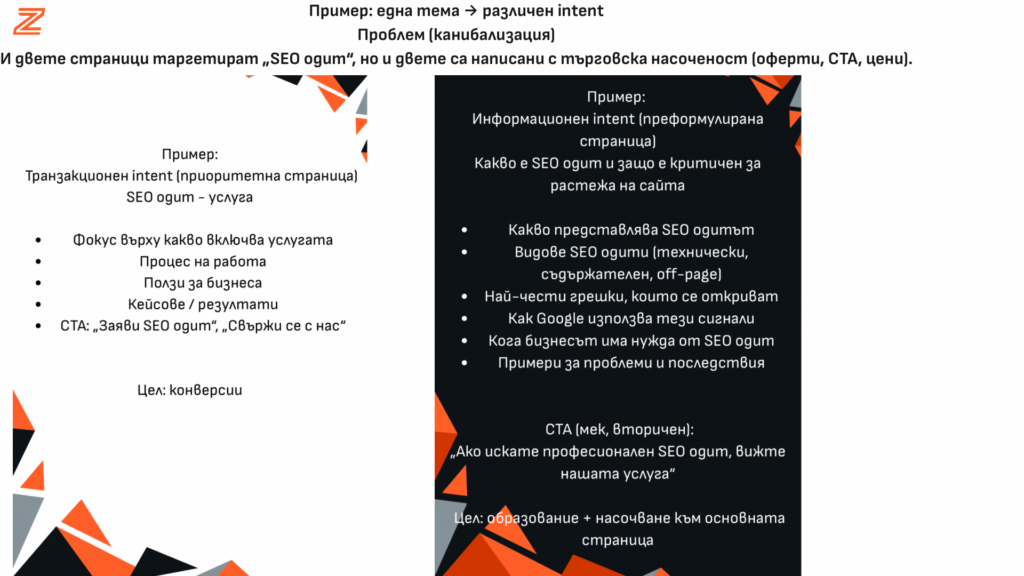
The two pages:
• cover the same topic
• but serve different search intents
• and do not directly compete with the main commercial page
When cannibalisation is not a problem
Not every overlap represents a risk. Sometimes Google deliberately displays different pages in different search contexts.
If the pages serve different stages of the user journey, they can coexist. In this case, you have a strategic topic cluster rather than internal competition.
Careful analysis prevents you from removing valuable pages unnecessarily.
Structure solves everything
SEO cannibalisation is not merely a technical oversight. It is a sign that your architecture needs discipline and clear prioritisation.
When you build a robust structure, concentrate authority and organise your topic clusters, your rankings stabilise, CTR improves and the algorithms understand exactly which page should dominate.
If you notice volatile rankings or an unexplained drop in organic traffic, conduct a strategic SEO audit and identify potential conflicts. Act early and turn internal competition into a concentrated force that moves your website forwards.
Frequently asked questions
1.How can I tell whether I have cannibalisation?
Check Google Search Console to see whether more than one URL is receiving impressions for the same keyword. If the pages serve the same intent, you probably have SEO cannibalisation.
2.Is cannibalisation harmful to every website?
Yes, when it dilutes authority and creates volatility in the SERP. It is not a problem if the pages address different search intents.
3.Can I solve the problem without deleting content?
Yes. Use a canonical tag, improve internal linking or implement a 301 redirect.
4.How long does recovery take?
Google usually consolidates the signals and stabilises rankings within 2–6 weeks of the correction.
5.How does Ahrefs help with the analysis?
Ahrefs shows which URLs rank for the same phrase, making it easier to identify hidden keyword cannibalisation.

Author
Martin Zhelyazkov
Founder of Z-Consult
Мартин Желязков е Founder & CEO на Z-Consult с над 15 години практически опит в дигиталния маркетинг, SEO стратегиите, автоматизацията и развитието на дигитални бизнеси. Фокусът му е в пресечната точка между SEO, AI, автоматизацията и бизнес стратегията — с цел сложните маркетингови и технологични процеси да се превръщат в ясни, приложими и измерими бизнес решения.
View author profile