Every day, thousands of businesses search for the ‘magic button“ in advertising platforms. The truth is simpler and more powerful than any secret formula.
Imagine marketing as a powerful amplifier. Connect a poor microphone and the sound will become louder, but remain just as unintelligible. That is exactly what happens when you launch ads without a validated sale. You amplify problems rather than solutions.
Understanding the relationship between sales and marketing is the key to sustainable growth and predictable results.
Put simply: marketing multiplies what already works in a live sales setting.
What is a sales funnel?
A sales funnel turns a live sales conversation into a digital architecture. It is called a „funnel“ because each stage filters and guides customers towards a purchase.
Looking for the ‘magic trick’ to rank in search engines and AI Overviews? The trick is to be relevant to user intent and provide comprehensive answers to users’ needs. This is not merely an opinion, but a recommendation from the source itself — Google Search Essentials: meet users’ needs at every stage of the journey, from awareness and decision-making to retention.
In summary: a funnel turns a chaotic buying process into a predictable system that can be analysed and improved.
Key principles
- Sales validate; marketing scales
- Funnel optimisation means removing obstacles
- Your website sells like an expert consultant
- The data speaks – we listen carefully
Examples of turning live interactions into digital experiences
Turning a headphone stand into an online shop
A technology exhibition provides the perfect laboratory for understanding the sales process. Every element of the interaction can be analysed and optimised.
The hook catches the eye in seconds. The simple message ‘Hear the detail, not the noise“ communicates a clear benefit without technical jargon. The demo stand allows immediate testing, removing doubt.
Instead of a monologue about features, a diagnostic conversation begins. Questions such as ‘What do you listen to most often?“, ‘Do you travel regularly?“ and ‘Do you work in a noisy environment?“ reveal specific needs. The answers point towards the right solution.
The demonstration speaks louder than descriptions. The customer hears the difference between models, tries the active noise cancellation and understands the practical benefits. Being honest about the compromises builds trust.
The digital transformation includes:
- Turning the demo stand into an interactive product configurator
- „What do you listen to?“ becomes a „Find your model“ quiz
- The ANC test becomes „before/after“ audio samples
- „A or B?“ develops into a comparison table showing the trade-offs
Turning a family holiday into a travel website
Here, the product is not something you can touch. It is time with those closest to you. The journey is longer and more emotional.
‘We want somewhere warm, but not too far away“ leads to Greece, Turkey or Spain. Then comes the choice of region, followed by two or three hotels. ‘What will we do there?“ Conditions, risk and budget. Finally, the booking.
The digital recreation includes:
- Turning „warm and nearby“ into destination hubs with filters
- Hotel tours become 360° virtual tours
- „What will we do in our free time?“ becomes maps of activities organised by time
- We develop the double room option into „Book now“ + „Ask a consultant“
In summary: every moment of a live interaction contains a lesson for digital transformation.
Why should sales come before marketing?
When a one-to-one sale is clear and repeatable, marketing simply presses the ‘multiply’ button. If the sales process is not properly organised, the channels merely distribute the chaos to more people.
Here is why:
• Validate first: The headphone stand proves what works
• Multiply afterwards: The channels multiply the live process
• The historical model: We turn market stalls into catalogues, then radio and, finally, Google Ads
The history of commerce reveals a clear pattern. First came market traders who perfected the face-to-face conversation. Then came direct mail, which multiplied that conversation across a larger audience.
Radio, television and the internet follow the same principle. Each new channel simply expands the reach of proven sales logic. When the live conversation begins to reach a mass audience, the need for structured marketing emerges.
Modern platforms such as Facebook and Google do not change this fundamental principle. They provide tools for scaling, but they cannot replace a clear value proposition and an understanding of customer needs.
In summary: marketing amplifies a proven process; it does not create a new one.
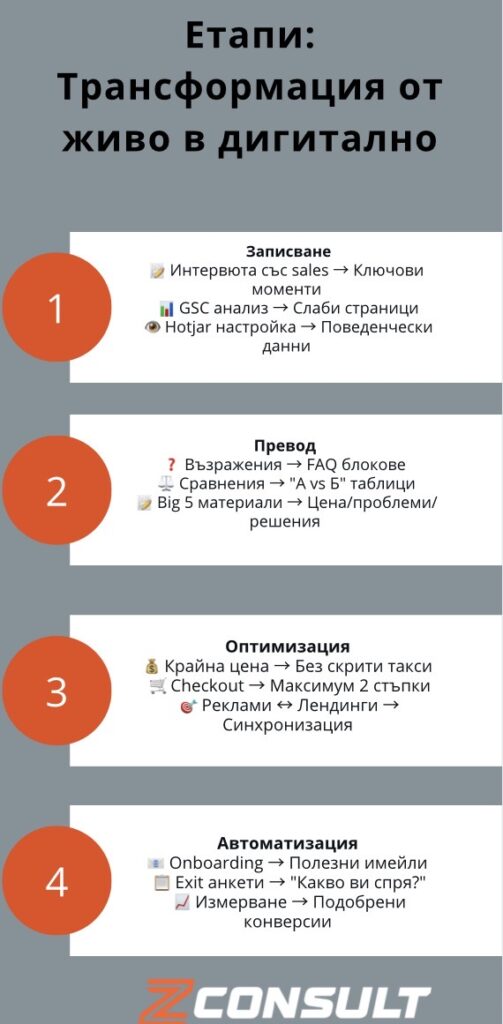
How to turn live sales into digital sales in 30 days
Effective funnel optimisation requires a systematic approach and consistent execution. This plan provides specific steps with measurable results.
In summary: small, systematic changes generate significant results by reducing friction and improving the customer experience.
How to analyse sales problems in marketing
Metrics communicate in clear language, but you need to know how to read them. The right diagnosis saves time and resources.
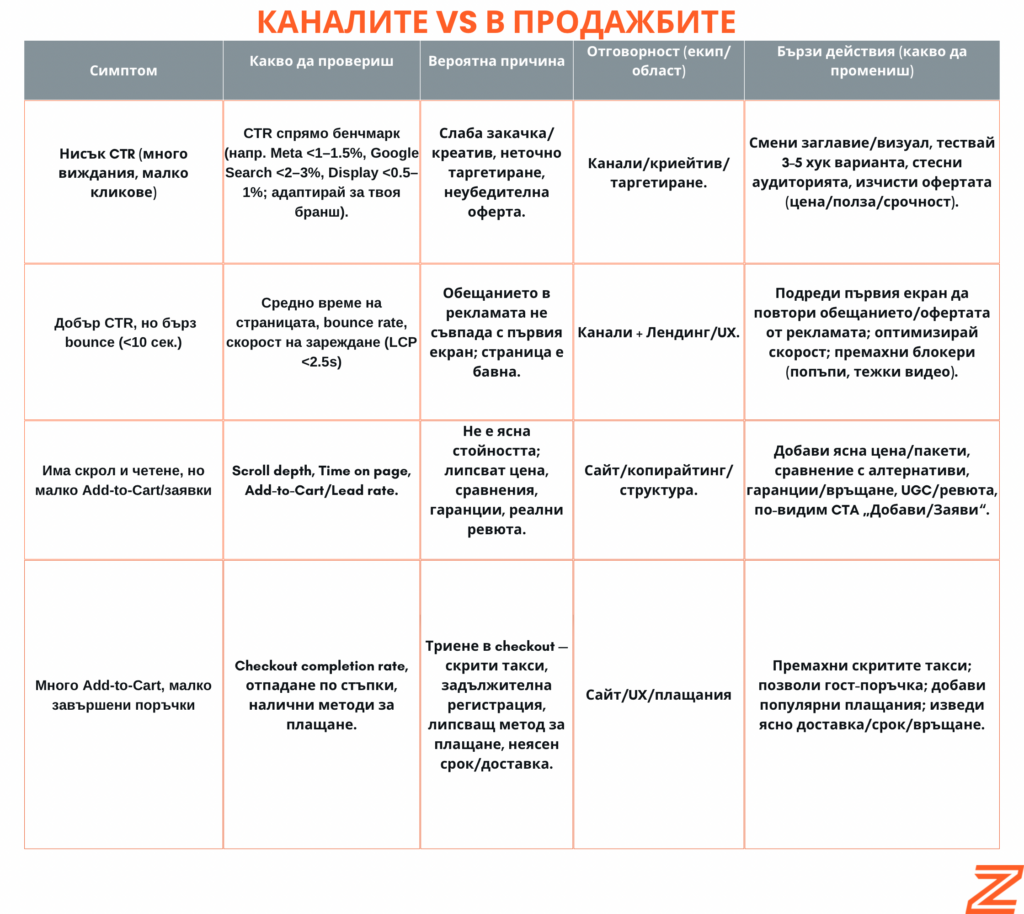
In summary: every metric tells a story that points towards specific actions.
Your website is a digital business card
Your website is a sales asset that works 24 hours a day. When designed properly, it functions as your best consultant.
Its structure should ask the right questions at the right time. Sections such as ‘Who is it for?“ and ‘How does it work?“ replace the diagnostic conversation. Interactive elements allow the experience to be personalised.
Evidence builds trust remotely. Videos, reviews, comparisons and case studies replace the physical demonstration. Authentic customer content carries more weight than marketing messages.
Risk management is critical to online conversions. Transparent pricing, clear guarantees and returns policies reduce anxiety. Social proof, such as customer numbers or awards, reinforces trust.
Making choices easier through filters, calculators and comparison tables speeds up decision-making. Complex products require more detailed navigation and personalised recommendations.
Closing the sale should be as seamless as possible. Guest checkout, multiple payment methods and a minimal number of steps reduce abandonment. Progress indicators show how much remains before completion.
In summary: do not cut corners on design, development, functionality or SEO — your website is both your digital business card and a key sales asset that pays for itself many times over through higher conversions and a better customer experience.
Transform sales into a scalable asset
The sales funnel is the bridge between individual expertise and systematic success. Once you understand how you sell in person, you can recreate that process digitally.
The right digital marketing strategy begins with a validated sale and transforms it into an automated system. Every stage of the live interaction has a digital equivalent.
Funnel optimisation is a continuous process of improvement based on real data and customer feedback. Small, systematic changes generate significant results.
Start today by analysing your current sales process. Identify the key moments and recreate them online. Every day of delay is a missed opportunity for growth.
Are you ready to turn a proven sales process into a scalable sales funnel? Get in touch for a tailored digital marketing strategy that genuinely increases sales without unnecessary noise.
Frequently asked questions (FAQ)
1.Which is more critical to success — marketing or sales?
Sales always come before marketing. They validate the offer and create the foundation for scaling. Marketing multiplies an already proven process.
2.Why do I have traffic but no sales?
The reasons usually lie outside marketing: an unclear value proposition, hidden or missing prices, insufficient trust, a complicated ordering process or a slow response from the sales team.
3.Can marketing compensate for a weak product or service?
No. Marketing amplifies existing quality. A weak product with good marketing leads to disappointed customers and negative reviews.
4.How can I determine whether the problem lies in marketing or sales?
A low click-through rate points to a marketing problem. A good click-through rate followed by a quick bounce indicates a mismatch between the advert and the content. Many add-to-baskets without purchases indicate a problem with the ordering process. Many inquiries with a low success rate point to a sales problem.
5.When is the right time to scale marketing?
When one-to-one sales are working consistently: a clear offer, predictable results, satisfied customers and positive recommendations.
6.How long does effective funnel optimisation take?
The first improvements become visible within 30–60 days. Full optimisation requires three to six months of continuous testing and refinement.
7.Which digital channels are most effective for a sales funnel?
It depends on the product and the audience. B2B companies succeed with LinkedIn and email marketing. B2C businesses use Facebook, Google and TikTok. They all begin with an optimised website.
8.What is the role of a marketing agency in this process?
An experienced agency helps identify problems quickly and implement solutions. It brings an external perspective and specialist tools.
9.Is digital marketing training worthwhile for an in-house team?
Yes, particularly for understanding the principles and improving internal coordination. However, practical implementation often requires specialist expertise.
10.How should I measure the success of the optimisation?
Track conversions at each funnel stage, time to first purchase, customer value and the repeat purchase rate. Quality metrics are more important than traffic volume.

Author
Evgeni Venkov
Co-Owner & Business Development
Евгени Венков е Co-owner & Business Development в Z-Consult с над 9 години практически опит в дигиталния маркетинг, бизнес развитието и изграждането на дългосрочни партньорства. Подходът му започва от самия бизнес — как печели, кои са клиентите му, какви цели преследва и къде са реалните възможности за растеж — преди да се изберат маркетинговите канали и конкретните действия.
View author profile