SEO is not dying – it is transforming
Every decade in the history of the internet brings new predictions about the end of SEO. Whenever Google releases a new update, social media gains momentum or new technologies such as artificial intelligence emerge, there are always experts predicting that search engine optimisation will become unnecessary.
But the reality tells a different story – SEO is not disappearing. It is adapting, evolving and becoming an even more important part of digital strategies.
Today, SEO lies at the heart of online success. Search is the natural way for people to discover new brands, products and services. That is precisely why SEO is not simply a technique, but a long-term investment in online visibility and trust.
A history of SEO’s ‘death sentences’
The early years of search engines
In the second half of the 1990s, optimisation largely came down to repeating keywords and using manipulative tactics – text in the same colour as the background, links from directories with no value and hidden content. These practices worked briefly because search engines were primitive at the time. But when Google introduced PageRank around 2000, the game changed. The focus shifted to links, authority and trust.
Florida Update (2003)
This was the first major blow to ‘black-hat’ techniques. Websites that excessively stuffed pages with keywords disappeared from the results. The prediction was that SEO would no longer serve any purpose. The reality: optimisation simply became smarter – with meaningful copy and a better balance.
Caffeine Update (2009)
This update changed the way Google indexed websites, making the process much faster and effectively real-time. Once again, people predicted ‘the end of SEO’, claiming that content would be indexed immediately and there would be ‘no need for optimisation’. The opposite proved true – SEO became even more important because faster indexing increased the competition for visibility.
SEO and the first professional strategies
Around 2003–2010, the first SEO agencies and professional practices began to emerge. Instead of focusing solely on keyword stuffing, the conversation expanded to link building, content creation and competitor analysis.
Social media and the first predictions of the end
When Facebook and Twitter went global in 2006, many predicted that social networks would replace search engines. In fact, the two proved complementary: SEO brings organic traffic from Google, while social media builds community and brand identity.
Google’s major changes
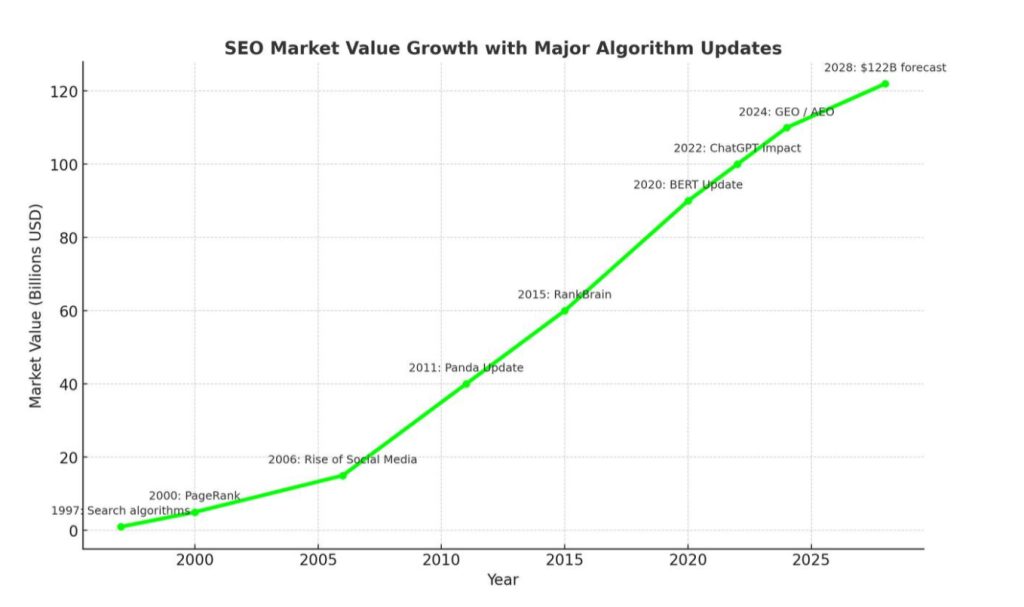
Panda Update (2011)
Google targeted websites with thin content and ‘content farms’. Many predicted that SEO was dying because ‘all websites would be penalised’. The reality was different – SEO simply shifted towards higher-quality content.
Penguin Update (2012)
This update targeted spammy links and excessive anchor text. Experts at the time said that link building no longer mattered. The truth is that links remained extremely important, but they now had to be natural and authoritative.
Hummingbird (2013)
With Hummingbird, Google introduced semantic search. The prediction was that SEO specialists would no longer be able to optimise websites because the algorithm could now understand context. The reality – SEO evolved towards better content that answers complete questions.
Mobilegeddon (2015)
The update gave an advantage to websites optimised for mobile devices. The prediction was that websites would disappear en masse. In reality, it simply accelerated the move towards mobile-first design.
RankBrain (2015)
Machine learning entered the search engine. The prediction: SEO would become ‘impossible to decipher’. The reality: the algorithm made results more accurate and required a better understanding of user intent.
Medic Update (2018)
The focus was on E-A-T (Expertise, Authoritativeness, Trustworthiness). The prediction was that small websites stood no chance against larger ones. The reality: SEO shifted towards expert authority and trust, which is actually an opportunity for anyone who can demonstrate competence.
BERT (2020)
The algorithm began to understand natural language and context. The predictions: SEO would become redundant. The reality: content had to become even more human and better written.
The age of artificial intelligence (2022–2024)
ChatGPT (2022): the predictions – AI would replace Google. The reality – SEO expanded into Answer Engine Optimization (AEO).
GEO/AEO (2024): the integration of voice assistants and smart systems. The predictions – SEO would die. The reality – new optimisation opportunities, particularly for voice search.
Every change brought panic and predictions of the end. The reality was that SEO simply continued to evolve, becoming better and increasingly necessary.
What SEO is today and why its importance is growing
More than keywords
Modern SEO goes far beyond simply inserting keywords. It includes:
- Technical optimisation – site speed, mobile compatibility, HTTPS security, indexation.
- On-page SEO – optimisation of titles, meta descriptions and internal links.
- High-value content – articles that solve problems.
- Off-page SEO – link building, PR and social signals.
- UX and user experience – ease of use, navigation and structure.
- E-E-A-T – expertise, authoritativeness and trustworthiness.
SEO as a strategic asset
Around 68% of online experiences begin with a Google search. This makes SEO one of the most important sources of traffic.
Benefits and drawbacks of modern optimisation
Benefits
- Long-term value – organic traffic continues to deliver for months and years.
- Authority and trust – high rankings build a strong reputation.
- Flexibility – from e-commerce to local businesses.
- Synergy – works alongside content marketing and advertising.
Challenges
- Time – results take 4–6 months.
- Complexity – algorithms are constantly evolving.
- Competition – difficulty in profitable niches.
Types of SEO and their role
- Technical SEO – accessibility and speed.
- On-page SEO – content and structure.
- Off-page SEO – external links.
- Local SEO – Google Business Profile, local links and reviews.
- International SEO – multilingual websites and hreflang.
- Mobile SEO – mobile-first indexing.
E-E-A-T and trust as the new standard
Google no longer looks only at keywords. It assesses:
- who wrote the content,
- whether they have proven expertise,
- whether the website demonstrates transparency and reliability.
Example: a small clinic that publishes articles signed by certified doctors has a chance to rank above large websites with no named authors.
Another practice is to use genuine customer reviews, official data and links to reliable sources. This shows Google that the content has been verified and can be trusted.
Local SEO – why it is crucial for small businesses
Local SEO is particularly important for restaurants, shops and service businesses. The main practices include:
- an optimised Google Business Profile,
- photos and opening hours,
- customer reviews,
- local links and directory mentions.
Example: a small restaurant in Sofia can outrank a large chain in local results if it has an optimised profile and plenty of positive reviews.
The future of SEO: generative search engines and intelligent systems
The rise of AI
ChatGPT, Google SGE and Bing Copilot have changed the way people search for information. This has not removed the need for SEO, but has added a new requirement – content must be authoritative and suitable for citation.
Structured data
Schema markup and rich snippets are now essential.
Local and personalised SEO
‘Near me’ searches, voice search and mobile optimisation will be crucial.
Video and visual SEO
YouTube, TikTok and Google Lens show that visual content is the next major wave.
Voice search and personalisation
With the growing use of voice assistants such as Siri and Alexa, SEO must provide answers to natural questions. Personalised results will make local optimisation even more important.
Practical examples of the power of SEO
To make it clearer how SEO works in practice, let us consider two different scenarios – a small local business and a large international company.
First, imagine a small family-run restaurant in Plovdiv. Before optimisation, it relies mainly on passing trade and word-of-mouth advertising. After the owner creates and optimises a Google Business Profile, adds up-to-date photos and opening hours, and begins encouraging customers to leave reviews, the restaurant starts appearing in results for searches such as ‘restaurant near me’. Combined with basic on-page SEO – appropriate titles and descriptions, as well as the inclusion of local keywords – the restaurant increases its bookings by more than 40% in just a few months.
The second example is a large e-commerce website selling technology. Competition is fierce because dozens of shops sell the same products. Instead of competing solely on prices and promotions, the website team invests in SEO content – ‘how to choose a laptop’ guides, reviews and comparisons. They also use structured product data – prices, availability and ratings. As a result, Google begins displaying the website in rich snippets, significantly increasing its CTR (click-through rate).
In both cases, SEO is not magic, but a combination of strategy, consistency and an understanding of users. The small business gains local trust, while the large one achieves greater visibility and authority. This proves that SEO works at every scale, provided it is applied correctly and sustainably.
Frequently asked questions (FAQ)
1.Is SEO dying?
No. With every change, SEO evolves rather than disappears.
2.What matters most today?
High-quality content, technical stability and ease of use.
3.Does a small business need optimisation?
Yes – through local SEO, small businesses can attract customers in their area.
4.Which tools are essential?
Google Search Console, Ahrefs, Semrush, Screaming Frog and Google Analytics.
5.How long do the results last?
SEO is a long-term process – results arrive after several months and the impact lasts for years.
6.SEO is not dying – it is evolving
Over the years, SEO has repeatedly been ‘buried’. But every prediction of its death has been disproved by reality. Rather than disappearing, search engine optimisation is becoming even more valuable: it builds trust, provides visibility and supports sustainable growth.

Author
Yordan Mirchev
BEO specialist
Yordan is part of the BEO/SEO team. He focuses on analysis, content, and optimisation according to real business needs.
View author profile