What are UX improvements and why do they matter?
UX (User Experience) improvements encompass all changes that make interaction between users and a website more intuitive, faster and more enjoyable. In 2025, UX is not simply ‘design’, but a key component of a growth strategy. High-quality UX improves engagement, retention and, above all, conversions.
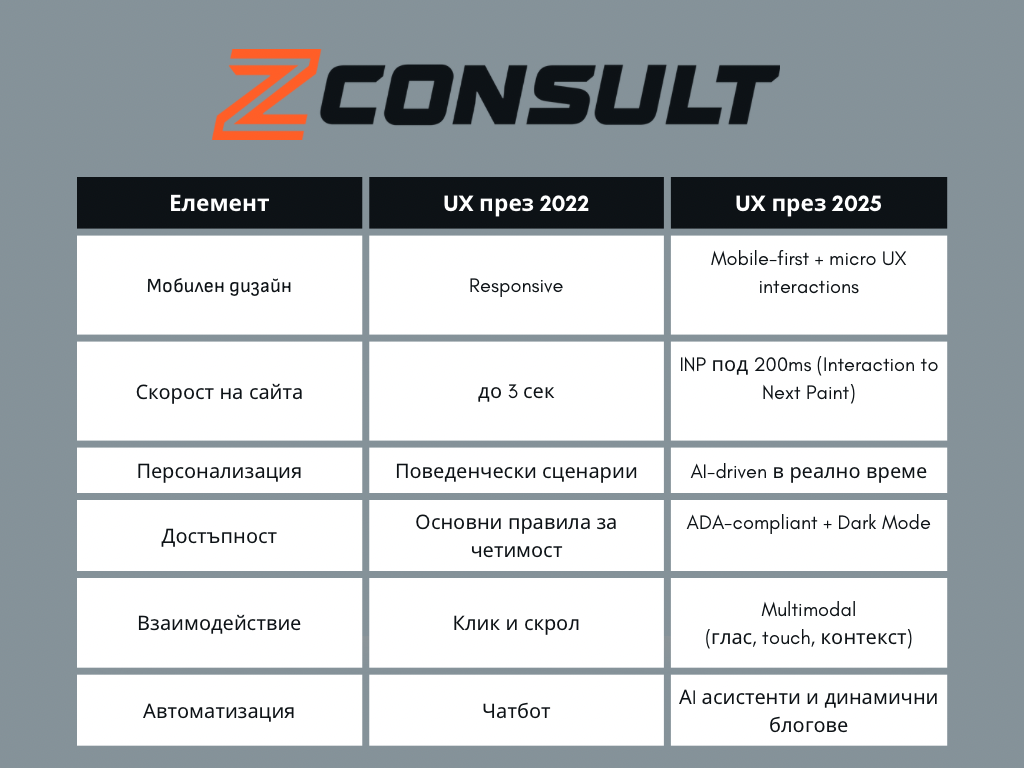
UX in 2025: What has changed?
1. UX improvements as a driver of higher conversions
UX optimisation leads to:
- A lower bounce rate
- More actions (clicks, registrations and purchases)
- More time spent on the website
In 2025, UX designers work closely with SEO, marketing and AI specialists to deliver a smooth and effective experience from the first visit through to the final conversion.
2. AI-driven UX personalisation
Modern analytics and automation tools enable:
- Real-time personalisation of content and interfaces
- Recommendations based on behaviour and previous actions
- Adaptation of visual elements according to the user’s device, location or mood (for example, through colour themes)
Example: A first-time visitor sees a different header from a loyal customer.
3. Core Web Vitals and UX in 2025
Google has updated its core UX metrics:
- INP (Interaction to Next Paint) replaced FID and measures how quickly a website responds to an interaction.
- LCP (Largest Contentful Paint) remains important and measures how quickly the main content is displayed.
- CLS (Cumulative Layout Shift) monitors unexpected changes to the layout.
UX improvements that enhance these metrics have a direct impact on SEO rankings and user satisfaction.
4. Multimodal UX and voice interaction
More and more users are turning to voice assistants, AI search engines and smart devices. UX must be adapted for:
- Voice commands
- Hands-free navigation
- Combined interfaces: voice + touch + visual cues
This is particularly important for mobile searches and products involving complex choices (for example, in eCommerce).
5. A ‘Zero Friction’ user experience
In 2025, users expect a seamless experience:
- One-click checkout
- No mandatory registration
- Form autofill
- Instant login via Apple / Google
UX improvements in this area not only accelerate the process but also reduce abandoned baskets and incomplete registrations.
6. Accessibility, Dark Mode and new UX standards
UX design now includes:
- The option to switch to dark mode
- High-contrast typography for better readability
- Support for keyboard navigation and screen readers
- Adaptations for people with cognitive or motor impairments
These practices not only make the website easier for everyone to use, but also improve overall user satisfaction.
7. How UX optimisation affects digital marketing
- Improved UX = lower cost per acquisition (CPA)
- More conversions without the need for more traffic
- A higher quality score for ads (especially in Google Ads)
- A smoother transition from an ad to content or a product
UX is now an integral part of every marketing strategy. It is not an ‘add-on’, but the cornerstone of a complete digital presence.
8. How business consultancy supports UX strategy
Consultants with UX and marketing experience can:
- Identify barriers in the user journey
- Recommend priority improvements that deliver a quick return
- Integrate UX with advertising and SEO strategies
- Forecast the impact of UX changes through A/B testing
Frequently asked questions
What is new in UX for 2025?
AI personalisation, the INP metric, voice navigation and a Zero Friction experience are among the main trends.
How does UX affect SEO?
Core Web Vitals directly affect Google rankings. UX improvements enhance a website’s metrics and its ranking.
Is it worth investing in UX if the website is already complete?
Yes. UX is not a one-off task. It is continuously optimised in line with user data and new technological standards.
In 2025, UX is not simply a ‘good experience’; it is a core business asset. Invest in UX optimisation and you will see tangible results: higher conversions, lower costs and greater loyalty.

Author
Martin Zhelyazkov
Founder of Z-Consult
Мартин Желязков е Founder & CEO на Z-Consult с над 15 години практически опит в дигиталния маркетинг, SEO стратегиите, автоматизацията и развитието на дигитални бизнеси. Фокусът му е в пресечната точка между SEO, AI, автоматизацията и бизнес стратегията — с цел сложните маркетингови и технологични процеси да се превръщат в ясни, приложими и измерими бизнес решения.
View author profile