Artificial intelligence is no longer an optional tool – it is the new standard in digital marketing. SEO prompts allow you to approach search engines strategically, discover new topics and create content that truly resonates with your audience. When we combine ChatGPT SEO prompts with proven practices from Google Webmaster Guidelines and insights from Ahrefs, we get a practical framework for achieving results. In this article, you will find 10 carefully selected AI prompts for SEO that will help you accelerate growth and build trust in your digital presence.
The power of SEO prompts
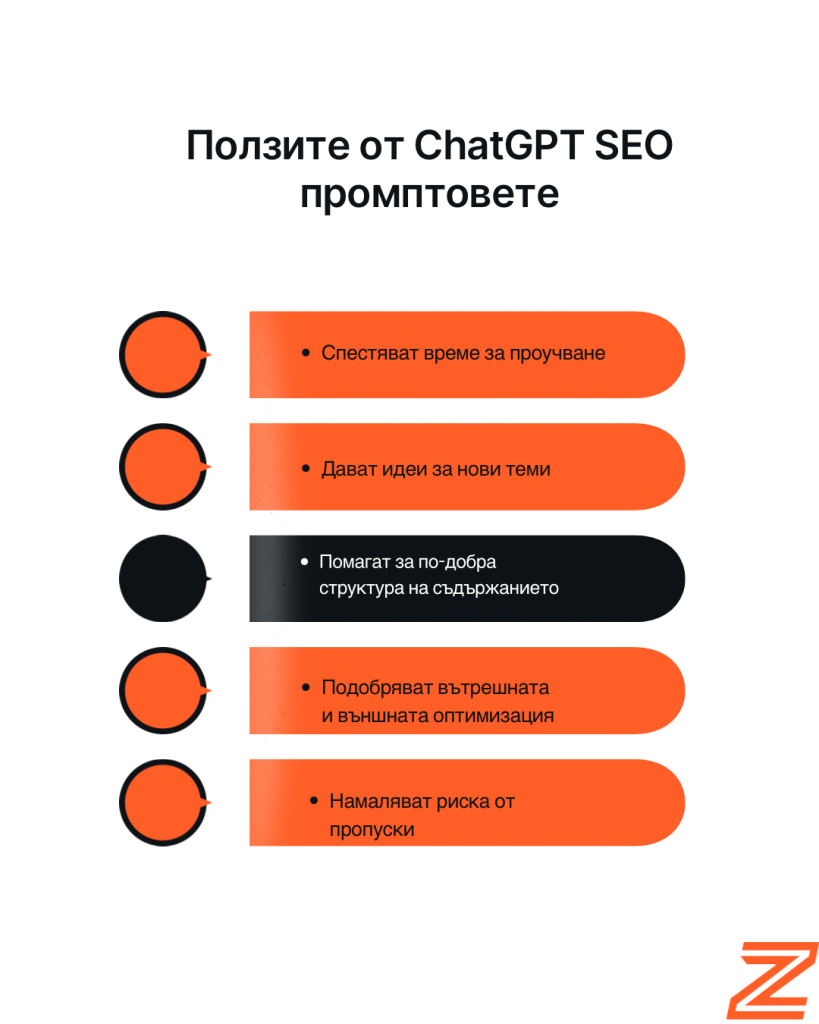
SEO prompts are no longer just an experimental idea. They are becoming a competitive advantage. Instead of spending hours on research and manual writing, you can use AI SEO automation to obtain accurate data, ideas and even ready-made strategies. The benefit is clear: speed and efficiency. The drawback is that if they are used formulaically, you risk losing originality and producing content with no expert value.
Prompts used correctly lead to faster optimisation and fewer errors, but they require experience and editorial oversight.
Top 10 SEO prompts for practical use
Each of the following examples is designed to solve a genuine SEO problem. They are based on ChatGPT prompts for SEO but adapted to local needs.
1.Entity SEO and semantics
“Identify the main entities, people, places and concepts related to [keyword]. Give me a JSON structure with entity → related LSI terms → contextual subtopics that should be covered in the content.”
Benefit: ensures that the content covers the full semantic spectrum and that Google views it as authoritative.
Drawback: requires additional validation to avoid including irrelevant topics.
2.SERP feature analysis
“Analyse the current SERP for [keyword] (based on the top 10 results). Identify which SERP features (featured snippet, People Also Ask, videos, images) appear and suggest how the content should be optimised to target these positions.”
Benefit: you can see the search engine’s actual structure and know which positions to compete for.
Drawback: the data is only a snapshot and needs to be updated frequently.
3.Content gaps and semantic clusters
“Give me topic clusters for [keyword], grouped by intent (informational, commercial, transactional). For each cluster, provide subtopics that competitors cover but I do not.”
Benefit: you can quickly identify gaps and opportunities for new content.
Drawback: it may produce clusters that are too broad and need further refinement.
4.EEAT content audit
“Read this text [insert text] and assess how well it meets EEAT principles. Give me a list of 10 specific improvements (authority, trust signals, source citations, expertise).”
Benefit: increases trust and compliance with Google Webmaster Guidelines.
Drawback: if the content is too weak, AI cannot compensate for a lack of experience.
5.Content refresh strategy
“Review this old SEO text [insert text] and suggest specific improvements for 2025 (new data, updated examples, outdated statistics, missing LSI terms). Also provide ideas for internal links to new articles.”
Benefit: extends the lifespan of content and keeps it relevant.
Drawback: requires time to implement the suggested changes.
6.Advanced internal linking
“Analyse a list of pages [URLs] and suggest an optimal internal linking structure by topic (topic clusters). Provide anchor text ideas based on the keywords and semantic SEO.”
Benefit: improves crawlability and distributes authority between pages.
Drawback: if implemented incorrectly, it can lead to cannibalisation.
7.Competitor backlink strategy
“Review the top 5 competitors for [keyword]. Develop a link-building model: which types of websites give them authority (media outlets, blogs, directories), which anchor text strategies they use, and suggest 10 new approaches to acquiring links.”
Benefit: you can see what works for competitors and replicate and build upon it.
Drawback: some links are inaccessible without contacts or a budget.
8.AI Overviews optimisation
“Create a text (40–60 words) that directly answers the question [user question]. Use a simple, clear style and structure it so that it is suitable for Google AI Overviews and featured snippets.”
Benefit: an opportunity to appear in zero-click results and AI summaries.
Drawback: you risk a low CTR because the answer is already provided in the SERP.
9.Search intent validation
“Determine whether the keyword [keyword] is informational, transactional or navigational. Give me a percentage breakdown of the intent based on the SERP results and suggest the optimal type of content for ranking.”
Benefit: you know exactly what type of content to create.
Drawback: with mixed intent, choosing the right strategy can be difficult.
10.Analytics-driven SEO
“Analyse a GA4 report [sample data] for landing pages with high traffic but low conversion. Give me 5 specific SEO recommendations (UX, CTAs, content optimisation) that will increase the conversion rate.”
Benefit: directly connects traffic with value and business results.
Drawback: requires GA4 to be configured correctly, as well as analytical skills.
These 10 SEO prompts are genuinely practical and can improve your results today, but you should use them as a foundation rather than a final version.
Why prompt engineering is the future of SEO
Prompt engineering for SEO is changing the way specialists work. Instead of relying on assumptions, you can extract data and recommendations tailored to your specific niche. Google Webmaster Guidelines clearly emphasise the importance of high-quality content and natural links, and the right AI prompts for SEO make these requirements easier to meet.
The future of SEO lies in the synergy between AI and human expertise
FAQ
1.What are SEO prompts?
They are instructions given to AI (such as ChatGPT) that help with content creation, optimisation and link-building strategies.
2.Which ChatGPT SEO prompts are the most useful?
The most effective prompts are those for SERP analysis, content gaps, internal linking and EEAT audits.
3.Can SEO prompts replace SEO specialists?
No. They accelerate processes but cannot replace human expertise and creativity.
4.How often should I use AI prompts for SEO?
Regularly. Especially when planning content and analysing competitors.
5.What are the risks of using AI SEO automation?
The main risk is producing duplicate or superficial content. This is why a human editor is always required.
SEO prompts are now an unavoidable part of a modern digital strategy. They accelerate analysis, uncover new topics and help create content that meets Google’s standards and audience expectations. The drawbacks are minimal compared with the potential they unlock.
If you want to build a winning strategy and outperform your competitors, start applying these ChatGPT SEO prompts today.
Contact our team and we will help you turn AI into your strongest ally in optimisation.

Author
Martin Zhelyazkov
Founder of Z-Consult
Мартин Желязков е Founder & CEO на Z-Consult с над 15 години практически опит в дигиталния маркетинг, SEO стратегиите, автоматизацията и развитието на дигитални бизнеси. Фокусът му е в пресечната точка между SEO, AI, автоматизацията и бизнес стратегията — с цел сложните маркетингови и технологични процеси да се превръщат в ясни, приложими и измерими бизнес решения.
View author profile